How to Monitor Landing Page Changes Without Manual QA
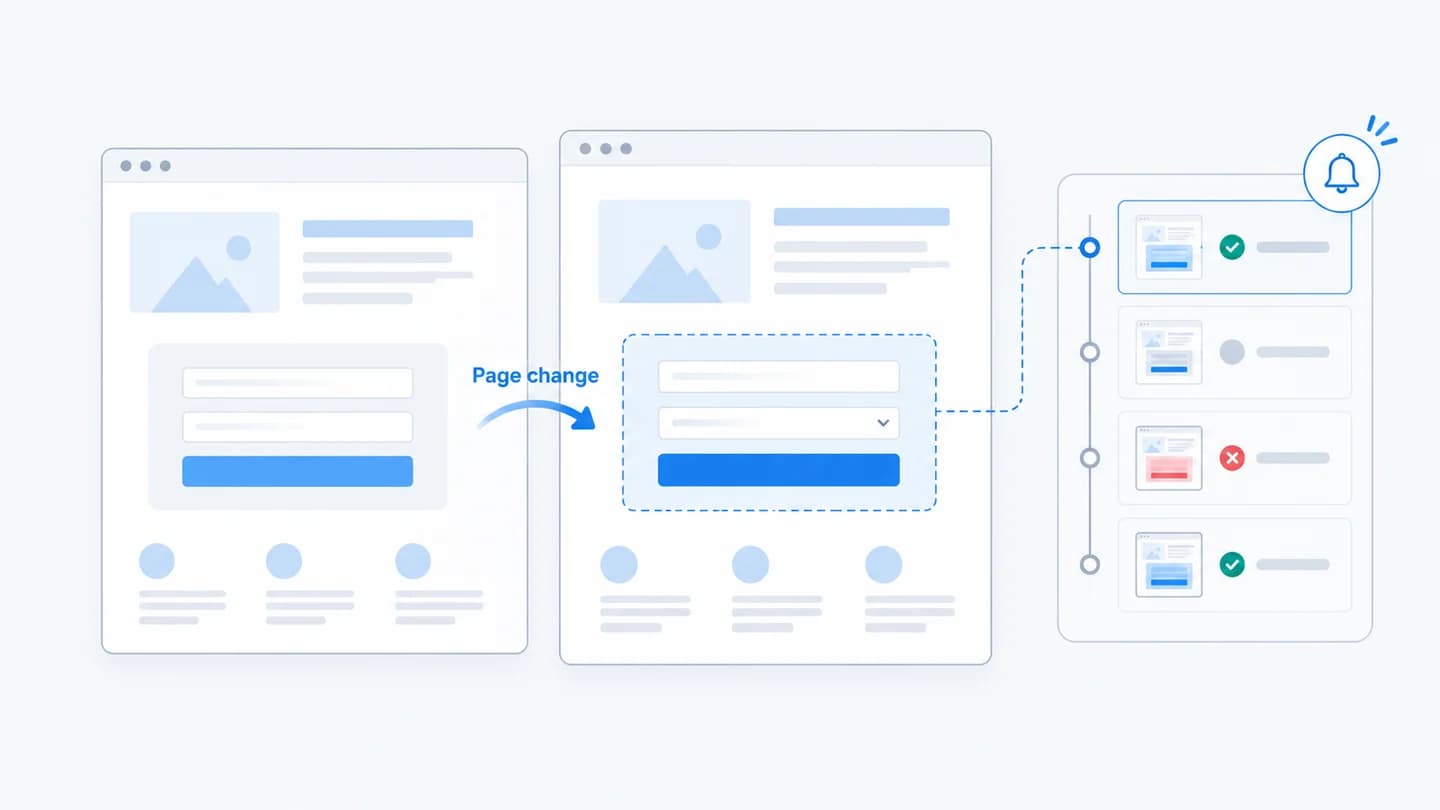
Manual QA works right up until the week everyone is busy. Landing pages change constantly (content edits, new scripts, CMS updates, third-party embeds), and the change that breaks conversion is rarely the one someone thought to test. The fix is to monitor the page continuously instead of checking it occasionally.
Why manual QA misses the important ones
- It happens on a schedule; breakages don't.
- It usually checks the page you deployed, not the page your visitors get after every script and A/B tool has loaded.
- It checks desktop, in your browser, with your cookies. The break is often mobile, first visit, with a consent banner.
- Nobody QAs a change they didn't know shipped, such as a marketer editing copy in the CMS, or a vendor updating an embed.
What to monitor
The page itself
- Does the page load, and how fast?
- Is the form present, and does it still submit?
- Did the content or structure change: new fields, moved CTA, new scripts?
The funnel around it
- Landing views → form views → form submits → leads in the CRM.
- Each stage's conversion rate against its own recent baseline, not a fixed target.
Watching both is what lets you say what changed and what it cost. Metrics alone tell you conversion fell; change detection alone tells you something shipped. Together they give you the cause. That pairing is what conversion incident intelligence means in practice.
Set thresholds that don't cry wolf
An alert on every wobble gets muted within a week. Alert on movement that's meaningful against the page's own baseline and sustained long enough to be real, not a five-minute blip.
Keep a change timeline
The single most useful artifact during an incident is an ordered list of what changed and when: page edits, form edits, ad edits, tracking edits. When conversion moves, the answer is usually already on that list. If you rely on people to write it by hand, it will be complete right up until the moment you need it.
Example
Illustrative scenario. A tag manager update added a script that failed on mobile Safari. The page still rendered, so nothing looked broken; form submits from mobile fell to near zero. Weekly QA would have found it the following Tuesday. Continuous funnel monitoring flags it the same afternoon, because the submit stage, and only the submit stage, collapsed.
How Quarkad helps
Quarkad monitors landing pages, form events, ad changes, and the CRM handoff continuously. When a stage drops against its baseline, it opens an incident with the changes that happened just before it, ranked by how well they line up, so the first thing you see is a suspect, not a chart. See landing page conversion drop and Meta Ads monitoring.
Related
- How a small landing page change can kill conversions
- Conversion incident intelligence
- Conversion drop diagnostic
- Marketing incident report template
FAQ
Isn't uptime monitoring enough? No. Uptime tells you the page responded. Most conversion-killing changes return a perfectly healthy 200.
What about A/B testing tools? They tell you how a deliberate variant performs. They don't catch the unplanned change that shipped outside the test.