How to Build a Conversion Drop Investigation Checklist
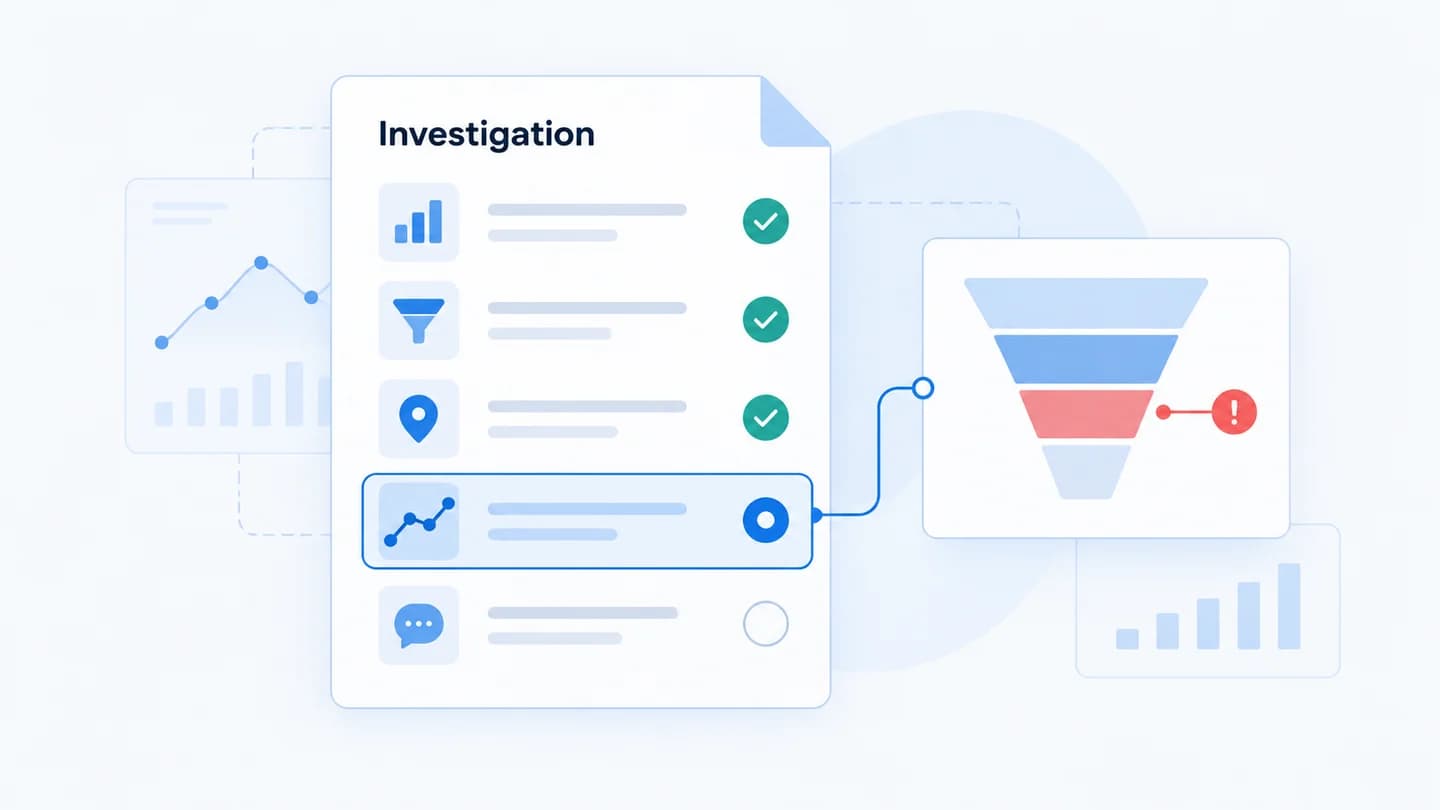
The difference between a five minute diagnosis and a five hour scramble is a checklist. Here is how to build one that walks a conversion drop from symptom to cause every time.
Step 1: Confirm the drop is real
Compare against your normal baseline, not just yesterday. A number outside the normal range is an incident; noise is not.
Step 2: Split the funnel
Pull visits, form views, form submits, and CRM leads for two periods. Find the stage that fell hardest. The conversion drop diagnostic does this in one step.
Step 3: Classify the stage
- Traffic → ads and delivery
- Page → layout, speed, redirects
- Form → fields, validation, submit, tracking
- Handoff → CRM integration and mapping
Step 4: Pull the change log
For the flagged stage, list every change around the time the drop started. The change that lines up with the drop is your prime suspect.
Step 5: Confirm, then communicate
Verify the cause, apply the fix, and send a clear client update. The conversion drop client update template gives you the wording.
What a good checklist entry looks like
Each step should say what to pull, where it lives, and what result sends you to the next step. Vague entries like "check the landing page" get skipped under pressure. A usable entry reads more like this:
- Pull: form views and form submits for the last 3 days and the same 3 days last week.
- From: your analytics form events, or the form tool's own counts.
- Decide: if submits fell more than views, go to the form section. If both fell together, go back to the page section.
Common gaps to close
Most checklists miss the same things. Add an owner for each stage so someone knows who to ask about a deploy, a link to where each change log lives, and a last step that records the cause and the fix. That record is what makes the next investigation faster, because the second time a cause appears you already know its fingerprint.
Example
Illustrative scenario. An agency runs the checklist on a client whose demo requests fell by half. Step 2 flags the form stage. Step 4 finds a validation rule added to the phone field on the day of the drop. The fix ships the same afternoon and the client update goes out before the client asks.
Turn it into a standing process
Document these steps once and every drop follows the same path. That is exactly the why did my leads drop framework, made repeatable.
How Quarkad helps
Quarkad runs this checklist automatically and continuously, detecting the drop, splitting the funnel, pulling the change timeline, and ranking the likely cause, so the checklist runs itself.
Related
- Why did my leads drop?
- The 7 most common reasons leads suddenly drop
- Marketing incident report template
FAQ
How detailed should the checklist be? Detailed enough that anyone on the team can run it and reach the same area, but short enough that it actually gets used.
Should every drop go through the full checklist? Only drops outside your normal range. Step 1 exists to filter out ordinary daily noise so the team does not run the whole process for a quiet Monday.